Avid gamer for the past 25 years, I focus mostly on Survival, RPG, and adventure games. I write reviews, and also like to share my general opinion on the gaming industry and where it is headed.
Say hello to my blog’s new home. I am really looking forward to growing this site and building a community that all enjoy sharing their thoughts on current generation games, retro gaming and the industry as a whole.
So comment, reblog, follow me on Twitter, I can’t wait to hear your comments and feedback.
If destruction, fire, and the occasional crushed sheep is your thing, Besiege is the game for you. Currently released in early access on Steam, Besiege is a physics based building game that allows you to build powerful siege engines to lay waste to the massive fortresses, tiny hamlets, and yes, unsuspecting sheep.
Developed by Spiderling Games, Besiege is a tinkerer’s play box. It drops you on a map with a clear set of goals, and lets you create whatever your mind can come up with to meet those goals. Currently limited to a series of tutorial maps, these goals can range from simple destroy missions, where you must destroy a certain percentage of the environment or troops on the screen, to obstacle courses and resource collection courses.
Not unlike opening a box of your favourite Lego as a child, Besiege gives you a variety of tools and equipment to build your creations. You need to figure out the right combination of components and moving parts to get the job done, and there are always multiple possibilities for each encounter. One early level for instance tasks you with destroying a tower located on a mountain, you can do so by rigging together some springs and pulleys and ropes to create a catapult or trebuchet, or maybe create a legged monstrosity to climb the mountain side, or a flying bomber that can rain hell from above. Your choices are limited only by your imagination and ability to take advantage of the game’s sometimes finicky physics engine.
The game also currently includes a sand box mode, which acts as a test ground for various designs with a variety of obstacles and targets to test your machines on. The real fun however is in the mission play and trying to figure out new ways to destroy your targets.
The visuals for the game, are cartoonish, and comedic, with massive explosions throwing debris across the map, or throwing soldiers up past the camera. Sheep splatter into satisfying pools of blood as your siege engines crush tme with spikes, bombs, and fiery balls of death.
With a quickly growing community of siege designers, a variety of both monstrous, and incredibly well thought out creations are also available to be shared and used in your own game, and each design can still be altered or improved for your own tastes. Individual components can also be redesigned and their effects changed to serve varying purposes, like increasing the tension on a spring, or the rotation speed of a wheel.
Though the structured mission play is currently limited to only one zone, with all of the bits and pieces available in the steadily increasing inventory, it’s not hard to find new and more inventive ways to cause havoc on each map. Besiege has shown a good start to a very creative game that you can spend minutes on, or hours trying to create that perfect weapon of destruction, or a perfectly balance flying contraption.
If destruction, fire, and the occasional crushed sheep is your thing, Besiege is the game for you. Currently released in early access on Steam, Besiege is a physics based building game that allows you to build powerful siege engines to lay waste to the massive fortresses, tiny hamlets, and yes, unsuspecting sheep.
Developed by Spiderling Games, Besiege is a tinkerer’s play box. It drops you on a map with a clear set of goals, and lets you create whatever your mind can come up with to meet those goals. Currently limited to a series of tutorial maps, these goals can range from simple destroy missions, where you must destroy a certain percentage of the environment or troops on the screen, to obstacle courses and resource collection courses.
Not unlike opening a box of your favourite Lego as a child, Besiege gives you a variety of tools and equipment to build your creations. You need to figure out the right combination of components and moving parts to get the job done, and there are always multiple possibilities for each encounter. One early level for instance tasks you with destroying a tower located on a mountain, you can do so by rigging together some springs and pulleys and ropes to create a catapult or trebuchet, or maybe create a legged monstrosity to climb the mountain side, or a flying bomber that can rain hell from above. Your choices are limited only by your imagination and ability to take advantage of the game’s sometimes finicky physics engine.
The game also currently includes a sand box mode, which acts as a test ground for various designs with a variety of obstacles and targets to test your machines on. The real fun however is in the mission play and trying to figure out new ways to destroy your targets.
The visuals for the game, are cartoonish, and comedic, with massive explosions throwing debris across the map, or throwing soldiers up past the camera. Sheep splatter into satisfying pools of blood as your siege engines crush tme with spikes, bombs, and fiery balls of death.
With a quickly growing community of siege designers, a variety of both monstrous, and incredibly well thought out creations are also available to be shared and used in your own game, and each design can still be altered or improved for your own tastes. Individual components can also be redesigned and their effects changed to serve varying purposes, like increasing the tension on a spring, or the rotation speed of a wheel.
Though the structured mission play is currently limited to only one zone, with all of the bits and pieces available in the steadily increasing inventory, it’s not hard to find new and more inventive ways to cause havoc on each map. Besiege has shown a good start to a very creative game that you can spend minutes on, or hours trying to create that perfect weapon of destruction, or a perfectly balance flying contraption.
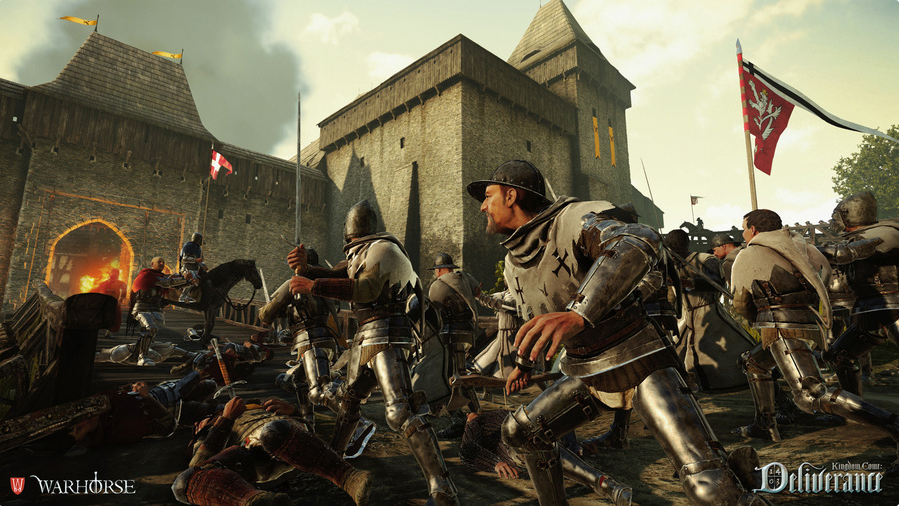
Currently in very early Alpha build, Kingdom Come: Deliverance is a “realistic open world first person medieval RPG” as per it’s developers Warhorse, a relatively new company comprised of several members of the teams responsible for the design of Mafia and Mafia 2. Taking with the crowd funding approach, WarHorse has raised millions from dedicated fans to fund their project.
Set in the back drop of historical Europe in the early 15th century, players will take control of a young apprentice blacksmith and will become involved in events that will shape the future of Europe. With plans for an open world, that allows you to progress the story at your own pace, the developers plan to give you open choice as well in exactly how you progress. Want to be a knight, and lead an army into the field, sure, or you can be a bard, and whisper sweet nothings into the ears of current leaders and gain their favor. The choice is yours.
Built with CryEngine, Warhorse studios have grand plans to present not only a very realistic game, but also very beautiful. The current build available to some people who have participated in the crowd funding effort is quite striking, and although only contains one small town is full of detail and beauty. WarHorse studios also promises a realistic combat based on actual styles from the time, so no taking on a dozen combatants yourself. Fights are tough, and can be slow paced dependant on the weapons and armour used.
As character goes, the developers have put an enormous amount of detail into not only character stats and tendencies, but even into the clothing you may wear, with over a dozen equipable slots and layered clothing to give a very realistic take on how clothes and armours of the time worked.
Pushing for as much true to history thought as possible, the designers have also added skill based crafting as a new challenge to players. In order to do well as a crafter you will have to practice, it will no longer be the case of simply repeating a task over and over till your level in that skill increases, you will be challenged with mixing the right components together at the right time to create potions, or leveraging a blade at the right angle to sharpen it and make a great sword.
With still a lot of development left, and with developers at WarHorse who are very active in the community, I am looking forward to seeing new features as they are released and how this game shapes up with it’s current release scheduled for late 2015.
War is bleak. And though games like Battlefield, and Call of Duty try to show us the “fun” side, filled with explosions and headshots, This War of Mine takes a very different approach and lets us peer in to the many survivers living through a war torn area.
Released in mid November, This War Is Mine is, brought to us by the Warsaw based 11 bit studios, is a dark, realistic survival simulation set in a war torn European city on the brink of collapse. You take control of up to 3 survivors living in a bombed out abandoned building, and must locate resources through scavenging, keep your spirits and health up, and defend nightly against other possible survivors who may try to raid your belongings.
The first thing that jumps out from This War of Mine, is the unique visuals, based in a side scrolling 2D environment you control your characters by point and click and are able to scavenge your new home for supplies while you try to build improvements that will make survival easier. The dark, almost monochromatic color scheme adds to the weight of the environments, but the excellent use of lighting adds an amazing amount of depth and life to both your individual characters as well as their surroundings. Visual queues are also given for the state of your survivors, as an injured friend will limp around from room to room, or drop his head low as depression sets in, to the point of sitting and being actionless once all hope is lost, unless you can find some way to reinvigorate their spirit through other characters motivation or maybe helping a neighbour.
Yes, the core gameplay of This War of Mine revolves around choice, and is broken into two major stages. Each day consists of a daytime period where you stay at home and can build improvements, or manufacture tradeable items like cigarettes and moonshine. You are given a limited time each day, so how you manage that time is critical to your success. Though you remain relatively safe during the day, you are often making critical choices that will affect the night or the next day’s chances of survival. Often times during the day you will also be visited by locals knocking on your door, sometimes there to trade, sometimes asking for your help, and other times there to do you or someone else harm. Not knowing what may be on offer as you approach the door gives some tenseness to each encounter, as even helping a neighbour could result in some misfortune coming your way later on. The ultimate effect of these encounters is when a neighbour asks for your help, and you simply don’t have the resources to assist, the gravity of these choices affects not only the player but the characters as well, as they feel sadness and fear, or even hope after tough choices like these are made.
In the night the game switches gears and allows you to venture out from your shelter to explore the local environments in search of supplies. At first you are limited to only a few locations, but these expand as you survive longer into the game. Each location offers a limited amount of supplies, and varying degrees of danger. You can also on occasion find other survivors willing to trade, but the greatest fear each time you go to a new zone is that of the unexpected. The questions swirl on whether you will find survivors there, and will they be friendly, or shoot you on site, and yes, death is a permanent in this game, and injuries to your characters can be just as grave given the limited amount of supplies you may safely be able to recover each night. Choice again is key during these night missions, as each character has a limited amount of slots and you can only carry so much in one trip. You also have to make the choice of whether to fill your bag from home with items to trade, or sometimes whether you are desperate enough to steal, often times from people in worse situations than yourself, like an old woman trying to nurse her husband back to health, but that fridge full of rare food items might tempt you doom that family in order to survive one more day.
The overall weight behind all these choices is the true momentum of this game, as each day you are forced to make difficult decisions which could result in yours, or someone else’s death or survival. This War of Mine does a great job of each of these choices, whether it be a simple choice of what new items to build, or where to scavenge, or the tougher choices of which of your survivors gets to eat each day, or use medicine when they are sick. Changing environments, and the limited pool of resources make each day harder than the previous.
This War of Mine, is an honest, and weighty depiction of what many actual survivors in a warscape may have to do on a day to day basis to keep living. The amount of choice and consequences allow for infinite replayability and the unique art style adds well to feel of lost hope, where every minor success is something worth celebrating.
This update comes with The Order: 1886. And it’s true. The game just isn’t what it should’ve been. Overcoming some issues with my recorder, I sit down with The Order: 1886 for the first time and play through this movie of a third person shooter.
With Nvidia recently announcing its foray into the console business in this article on IGN.com, with it’s release of the Shield console, featuring their game streaming service The Grid, I began to think about the past of physical media and the potential future of how we may be gaming in the near future.
Before the advent of affordable compact disk drives, we gamers were all quite used to a massive case of floppy drives, be they 5 1/4 or 3 1/2, we knew we’d be spending potentially hours with installing larger games onto our PC’s with multiple disk changes along the way, and heaven forbid any of them ever got scratched! Our hearts would sink, and we’d scramble to see if a friend had a copy of the install disks so we could start over. Console gamers faired a little easier, with their mostly less bulky cartridges in over sized plastic cases. We would figure out ways to stuff a dozen of them inside a knapsack with our consoles to bring to our friends. In general we avoided magnets and spills, and hoped the batteries in the cartridges didn’t die and delete all of our saves.
Obviously gaming media has evolved over the years, from those very disks, and cartridges, to compact disks with their own accomplishments of getting to that next disk in big games like Final Fantasy VII for example, and dvd’s and then Blu-Rays. Able to store more and more information with each evolution and become more durable as well. One of the last steps being the direct download. Imagine, no media at all. You don’t even have to step from your home to the store, or mailbox to get your game, just click the link and wait till it’s nested itself on your hard drive, ready to install. The real reflection however is how the technology has mirrored the general need in current society for more and more immediate gratification. Enter streaming.
Now there is no longer a need for media, even your hard drive needs minimal space, click the link, start playing, and hope there is no lag. So how does this effect the industry as a whole? We already know that more and more publishers have gone away from offering hard copies of their games, and rely on direct downloads or Steam to get their products out, though it’s not measured if this is cheaper for the publisher, and results in better overall pricing for the consumer. This is especially apparent with big AAA games that cost the same whether a physical copy or a digital copy is purchased. As a consumer we’d think that downloading and not forcing the publisher to make all those expensive disks should result in cost savings for us, but it doesn’t usually work that way.
Where streaming will differ greatly in this equation is the need for the providers to run full servers that can handle the load of their customers’ demands without hiccups in service, or the aforementioned lag. This leaves us with immediate gratification of multiple titles available immediately with no wait, but the added costs of funding the providers to make sure we don’t experience slow downs or poor quality. We’re sure to see our average costs for this “convenience” far exceed our need for immediate gratification.
The nostalgic part of me fears the potential shift to more and more online only content, and the lack of a true feel for the collector’s heart that many gamers share. A shelf full of titles to show off to friends was always a part of the pride we felt when building our collection of games. That pride will now be shared with anyone who subscribes to the service, and diminished greatly as a result. As our need for more and more immediate access grows, are we leaving some of the fun behind?
I have just spent several hours with Boid, a simplistic 2D RTS that has you take control of several amoeba like organisms in underwater cavernous environments and pits you against an equal foe located on the other side of the map. Brought to us by indie developer tinyBuild Games, also known for the satrical “No Time To Explain”.
The idea is simple, take over all control points on the map before your opponent can. Control points are broken into two basic categories, spawn points that slowly spawn new troops up to a maximum of five at a time, and evolution points which allow you to morph your creatures into various upgraded forms, like a strong crab like creature, a long range laser canon, and speedy scouts among other variations. You are tasked with controlling your flow of new units while strategically choosing which path to take and which upgrades to use and balance everything accordingly. All actions are controlled by a simple click of the mouse, and a side panel gives you a brief summary of units available, and selected, and you can use waypoints to help automate some of your troops to specific defense points or upgrades to capture.
Both offline and online modes are already included in the most recent build. The offline version features a fairly good A.I. which can challenge new comers to the game and is a good way of getting acquainted with most of the unit types, and general gameplay. Multiplayer of course is where a game like this shines, as adapting to a human player’s differing strategies and changes of pace are where the real challenge and fun is. With the recent addition of leagues, and ranked play, you can easily lose hours to Boid.
Graphically Boid’s 2D graphics are simple, yet colourful and make it easy to identify unit types by their shape, as well as identify enemies. Winning and losing spawn points is shown graphically by quick flashes of light on the screen to give you a quick clue that you may need to investigate elsewhere. The submerged aquatic setting is full of life, and the lighting effects give great depth on what is otherwise a flat world.
Available now on the Steam Early Access program at a measly $3.29 CAD, Boid is a steal for anyone looking for an easy to pick up, but competitive RTS. One that is being well supported by the developer with regular updates and improvements.




 MicBeMac Games