Review: The Flock

The Flock, an asymmetrical first person game of tag with a twist, when every dies at least once, the game comes to an end.  Unfortunately it’s hard to see the current population of 215 million plus actually wanting to play long enough to die that many times.

The basic premise of The Flock has all players starting off as strange gargoyle like creatures.  Your creature can run, jump and scamper, and when you stand still you become stone, and impervious to your prey.  There are no other attacks or actions, or special moves you can do as the gargoyle.  Your first objective from here is to lactate the light.  The light is basically a big flashlight with a terrible battery.

Once the first player finds the light, the game play changes slightly as you the carrier of the light are now the prey of everyone else and becomes a simpering weak human.  Taking away all the movement advantages of the gargoyle creature, you are left with only the light to protect you.  As the human you can only walk or sprint, you can’t jump or crouch or crawl or anything else.  You’re only protection is your flashlight which can burn up the other players who remain gargoyles.

Here the objectives change slightly, as now you as the human must run and hide from other players, while waiting for objectives to light up that you can activate for extra points.  You also gain points the longer you carry the light.  The other players adversely are trying to find you and attack you to take over the light.  The light however hurts them and their only protection is to stay still to avoid damage.

The flock
Well it’s kinda bright

This seems like a interesting concept, but it’s lacking in various areas.  For one, as compared to other asymmetrical games like Evolve, there is absolutely no teamwork involved here.  Everyone is out for there own score and objectives.  There is no in-game chat or any other form of communication to use, nor is there any benefit from working together as each individual is simply trying to get the highest score each match.

The other big issue, is after a match there is literally nothing else left to do.  Each match is the same, regardless of what map you choose to play on.  There is no variation to the game, nor is there any development to your skills or abilities.  There is literally  no replay value here.

The flock
The beautiful color pallet astounds

There’s not really much to look at here either.  Visually The Flock is drab and repetitive.  Every map though unique is dark and grey, with very little variety.  Though I will say there are generally some interesting areas to set up ambushes if you’re patient.  Character animations are also very limited, as you can see the gargoyle characters warping across the land and generally looking silly and un-detailed.

Sold as a horror game, there’s little to be afraid of with The Flock aside from wasting too much money on it.  With zero story progression, no replay ability and no other modes to try out, there’s little chance I will see the end game when 215 million other players die.

Thanks for reading, and as always, make sure to comment and like below, and let me know what you thought of The Flock.

Check out my review for Evolve for something much better to play.

Mini Reviews: NewGrounds

Www.newgrounds.com is an exciting and entertaining hub of innovative gaming, videos and audio.  With so much free content to check out, it’s a great source for incredible entertainment.  Join me as I quickly review a few great new games found on NewGrounds.


There is no Game

There is no game

Like the title implies, this is no game.  This is an experience.  A great satirical point and click adventure, This is no Game’s narrator taunts you thoroughly as you try to figure out what to do next.  As you click around the screen searching for something to do, the game keeps throwing surprises at you.  As you discover more, your heavily accented host shows more and more disdain for your desire to find the game within the lack of a game.  The clever humour, and absurdity of it all, is charming and fun.  The few short puzzles are not much of a challenge, but the taunting from the narrator is often worth not figuring out the puzzles for awhile, just to see what he will say next.


Hero Simulator

Hero Simulator

An endless earner, Hero Simulator has you building up the next generation of hero to take over from their father after 200 years of service.  As with most endless earners, you start off small and quickly go big.  Hero Simulator is set apart slightly however by the sheer amount of earning choices, and the save feature that allows you to earn while offline from the game as well.  Closing the screen and and coming back several hours later will surprise you with a bounty of resources to spend.  There’s also an extra level of strategy here as random discounts, and bonuses will generate that allow you to buy items on a discount, or invest cash with less risk of losing.  These small features add a very addictive nature to the game as you keep popping your head back in to make sure you aren’t missing any great deals.


Tiny Treasure

Tiny Treasure

Tiny Treasure is a really clever side scrolling adventure.  You take control of two knights as they venture into fields and caves to find treasure.  You must surpass a bunch of jumping puzzles by using both characters to help you past each obstacle.  A click of the space bar takes control of one or the other knight, who’s corresponding coloured blocks become transparent, allowing that character to pass through them.  It’s up to you to switch back and forth between each character and figure out each increasingly difficult pattern to make it to the next area.  The blend of puzzle solving along with accurate jumping skills is challenging and addictive.


As always, thanks for reading, and don’t forget to like and comment below, let me know if you have tried any of these games.

Check out this great channel review, The Neo Nerd

DeathTrack: Rewind Review

Welcome to 1989, when the near future was bleak. Bleak enough that the preferred sport around the world was DeathTrack. A race to the finish, or survival, for any driver brave enough to make his way onto the track. One of the early great predecessors to games like Twisted Metal, DeathTrack had you taking on 8 other racers in a do or die race to the finish.

With names like Wrecker, MegaDeath, Killer Angel, and Melissa… (wait ‘Melissa’?) Yes, Melissa, you face off against drivers ready to kill to win. Coming to us in full 16 colour, EGA graphics, DeathTrack was an awful looking game to today’s standards.  It did offer a fairly consistent look however, and ran well on the machines of the time.  Each driver had a unique look, as well as a unique vehicle. The Hud was very busy, but everything included had an important function. You could easily see the map layout, enemies ahead of you, weapon status, as well as damage and fuel levels. Incoming attacks were also displayed on your screen to give you a chance to avoid mines, caltrops, or the deadly Terminators. No, not the Schwarzenegger type.  Each drivable vehicle came with it’s own differing HUD, though all the same items were displayed in relatively the same spots.

Deathtrack
Look at all those polygon(s)??

Depth in this game was impressive. Winning a match meant not just maintaining speed. You had to monitor your fuel, your ammo supply, as well as avoid or kill your opponents. Managing all of these things at the same time made for a difficult to master game. The assortment of starting vehicles was limited to three, one focused on pure speed, one on attack prowess, and the last on armour. At the beginning of each career you could choose your starting vehicle along with a small assortment of weapons and vehicle upgrades.

Weapons were comprised of 5 basic types. You could use direct fire lasers, plasma beams and machine guns, or mines and caltrops you could drop behind you, or physical weapons like spikes and rams, or missiles, or the deadly terminators which were fast missiles on wheels that would follow the course and explode on the first car they hit, including yours.  A well placed Terminator could mean your win, or your end.  Every weapon type came with 3 levels of effectiveness at increasingly high costs.

Deathtrack
Lots of ways to blow stuff up.

At this same time, you could also upgrade various components of your vehicle.  Armor, tires, engines.  All of these components also had a set of 3 levels to choose from to enhance your vehicles’ prowess on the track.  The initial cost of these upgrades is pretty high, and you need to win races to afford them.  You also have to be aware of damage from your races, as each race will have you pay for repairs before you move on.  Get wrecked and you may have to downgrade your components just to afford to race again.

The 10 tracks available in the game offer some subtle differences, but the fairly basic polygon graphics don’t really offer up too many differences from map to map.  Some blocky buildings, or shaggy looking palm trees might help distinguish St. Louis from Los Angeles, but little else.

deathtrack
Sure, it looks good now…

Sound in the game was also pretty basic, with only one or two short tracks on repeat that you generally began to ignore after a round or two.  These deficiencies never really affected the addictive gameplay however.  You always felt the urge for that next race, especially after getting wrecked.  Revenge on the track is so sweet.

Deathtrack
Wrecked…

A game released near the end of the run of 2d racers, DeathTrack had a whole lot going for it.  It wasn’t pretty, and it definitely didn’t sound good, but it’s addictive racing gameplay, and wanton destruction was hard to resist.  The depth of mechanics and customization also set it apart during it’s era of gaming.

Check back next week for another Review Rewind, and don’t forget to read last week’s Rewind too!

Follow me on Twitter @micbemac88 and don’t forget to comment below, let me know if you have played Deathtrack!

Game of Thrones: Episode 1 review

Game of Thrones
My long journey begins in Game of Thrones

There was a lot of death involved in my first playthrough of Game of Thrones. When I say first playthrough yes I do mean I will be diving back into the story repeadetly. TellTale’s Game of Thrones follows their usual recipe of story moments, quick time events and tough choices, each of which reflects how your story develops. Based on the television version of Game of Thrones, you play as members of the Forrester house. A small family not mentioned in the show, but a part of the army from the North. Like the show, you shift from character to character and place to place in order to push the story forward. Throughout your play you are given choices on how to interact with other characters, or actions to take that will affect the story as it unfolds.

This first episode of Game of Thrones starts off during the sequence fans will know as The Red Wedding. As someone who is a fan of both the books and the show, it was interesting getting yet another perspective on these events as they unfold. Fans of Game of Thrones have seen the events of the various storied unfold through the perspective of various important characters, the game however allows us to see through the perspective of characters caught in fallout. Because of this the, choices you make early on lack some weight. We know that as minor characters our choices won’t have much effect on the overall story surrounding us. TellTale however, not unlike in The Walking Dead series, does a great job of developing your primary characters so that as you learn to know them more, each decision becomes harder, and harder. Unlike the Walking Dead series however, as the focus shifts through various characters, it does take longer to grow this connection.

Game of Thrones follows a similar art style to Telltale’s previous games, with an earthy colour palette, and painted on effect to each scene. Environments are incredibly detailed, and they often throw in touches directly from the show to connect the two medias. This is particularly fun in the in game recreation of the opening credits for the HBO show as we fly across a 3D map of the world. Death and injury are prevalent in Game of Thrones books, and this version doesn’t shy away from showing blood and gore. We even get to enjoy a closeup of our characters torn leg as a Maestor stitches us up.

Game of Thrones
Is this going to hurt?

Various characters from the HBO series show up prominently early on, and are voiced by their actual cast members. This gives the game a solid production value. Even the other voice overs for the lesser known characters are done well and show genuine feeling. Though some of these interactions feel somewhat forced in order to get some of these familiar characters involved in your story, it’s still fun seeing them in their animated forms.

Game of Thrones
Have I met you before somewhere?

With choice being at the forefront of this game, I do enjoy how your actions often have immediate repercussions. And I am very curious how the bigger actions and choices will affect the Forrester’s family outcome by the end of episode 6. The amount of choices available make you want to dive right back in to try the opposites to your original choices to see each outcome. I honestly had to question whether to dive right into episode 2 and live with my choices, or try again and see if I could get a better outcome. This replayability factor, and the overall look and playability of the game make this a must play for most gamers, and especially those who are a fan of Game of Thrones.

Overall 9/10

For similar games, check out these reviews also;
Life is Strange: Episode 1
Life is Strange: Episode 2

Life is Strange Episode 2: Review

Life is Strange Episode 2

Life is Strange Episode 2: Out of Time was released recently and continues the story of Max Caulfield and friends. As in episode 1, you find you have the ability to control time for brief moments. The ability allows you to sometimes go a few minutes into the past and relive moments in time. The mechanic continues to work well in this episode, but sadly we are not introduced to anything gameplay wise that we haven’t already seen in episode 1.

The story leaves off shortly after our hero Max revealed her powers to her once bff Chloe. We are set loose immediately to continue investigating the strange occurrences around the small boarding school where most of the story proceeds. Unfortunately and ironically, the greatest weakness of episode 2 is its use of time. The pace of the game at this point seems to itself go back in time. Your first few missions involve very mundane tasks, and don’t often elevate the story, but rather give you something to do until an important event occurs. The game gives you another opportunity to test out your powers answering questions, then going back in time to get the right answers if need be. These small, tutorial style events were handed out often in the first episode, and feel a little out-of-place here. At one point the story nearly stops completely to have you blindly trudging around a garbage dump on an annoying, online RPG style collection quest. Direction at this point is unclear, and though through you’re searching some small tidbits and collectables are revealed, there is really no story here.

The pace of the game doesn’t really quicken up until the very end of the episode when you are given very heavy choices to weigh, where lives are on the line. Though one of these events again doesn’t really add much to the overall story. It really feels more like a puzzle that needs solving in order to extend your play through time.

One thing episode 2 does address well is the lack of consequence from episode 1. In episode 1 we made many small choices which I have not clearly seen the effect of in my current play through. Major decisions however do come back to haunt you or help you regularly. The other item of consequence that is addressed here is the effect of using your powers has on Max and her surroundings. In the first episode it felt as though there was no real way to fail, as you could easily reverse time and try again. Episode 2 does a much better job with this and gives you several major choices and consequences which directly affect future events.

Overall I spent just over an hour with episode 2, making its value feel short compared to the first episode. This is especially true with the amount of time I spent lost or confused as to where to go next. You only visit a few environments, and 2 of these we have been to before, so there is little pushing the player to re-explore these familiar zones. Many of the talking points are the same that were available in episode 1, and the environments themselves feel smaller and not as full of life as they did previously. The overarching story however still has me intrigued, but I hope in future episodes that the pacing is quicker and that there are less filler quests between story points. These story points usually have weight and emotion tied into them, but small in between actions we take as the player rarely have any pay off once we get there. Hopefully in future episodes we will be pushed more to explore and interact with our environments to effect change in the story, rather than to keep us in the game a little longer.

Overall 6.5/10

You can read my original review of Episode 1: Chrysalis here.

World Of Warships: Beta Preview

Time to engage!
Time to engage!

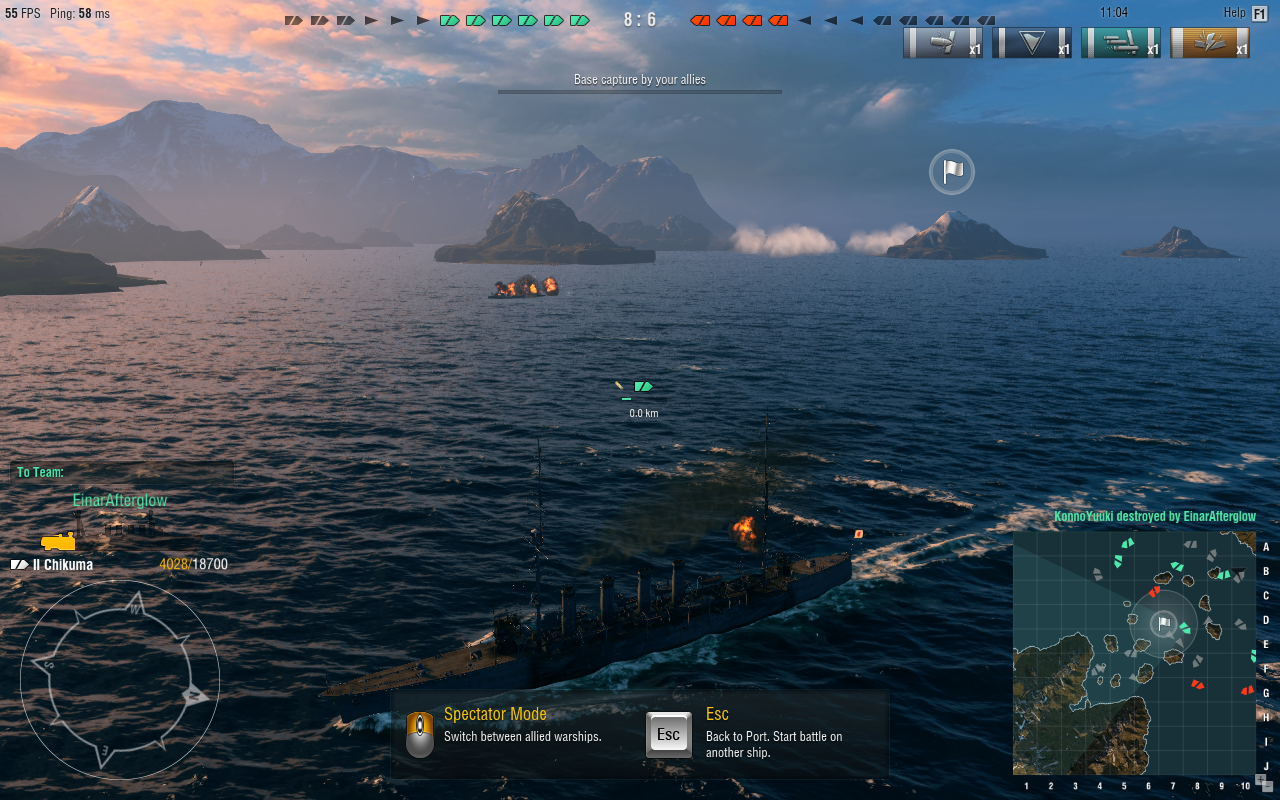
World of Warships is an action packed tactical wargame. Emphasis on the action. Taking from their previous games, Wargames.net uses the same mold with World of Warships. The free to play model gives you instant access to one tier of small warships to start your campaign to collect them all. Like with Wargames.net previous entries, World of Warships has you earn experience points and cash that allow you to research and buy new ships and upgrades. From my early closed Beta test experience so far, they have done an adequate job of not making new equipment and ships seem inaccessible. You can generally find yourself able to afford a new ship after only a few battles, assuming you can hit the enemy on a fairly regular basis.

It's a lot of fun watching enemies explode.
It’s a lot of fun watching enemies explode.

Early gameplay is pretty fast paced as early ships are small and maneuverable, and don’t carry much fire power, nor hit points. These first few battles are quick and allow you to get used to the basic controls, navigation and firing techniques. Though the actual combat is more action oriented, and not a true simulation, it still takes a fair amount of skill to judge distance and speed before firing your canons, or loosing torpedoes.

As you gain experience, higher ranked ships become available. These ships vary in class from cruisers, to destroyers, to massive battleships or aircraft carriers. World of Warships does a great job offering a varied amount of combat once these second and third tier options open up.

Cruisers, the first ship type you have access to, offer balance in performance and firepower. They are fairly maneuverable and the higher tiers carry both an assortment of guns, as well as torpedoes, and anti-aircraft flak guns. Destroyers are fast and highly maneuverable. They tend to favour those who enjoy the torpedo game and can move quickly into range to fire, and escape by dropping smoke screens to hide themselves and allies. Battleships are the heavy hitters, and tend to stay at range firing massive guns for similarly massive damage. The aircraft carriers offer the most unique play experience, as they mostly lack any direct fire weapons and must rely entirely on their loadout of planes. When choosing and aircraft carrier, you find yourself generally moving between an overhead tactical view of the entire battle, and to your various planes, either fighters, bombers, or torpedo bombers. This mix of styles is very welcome, and offers variety to each battle.

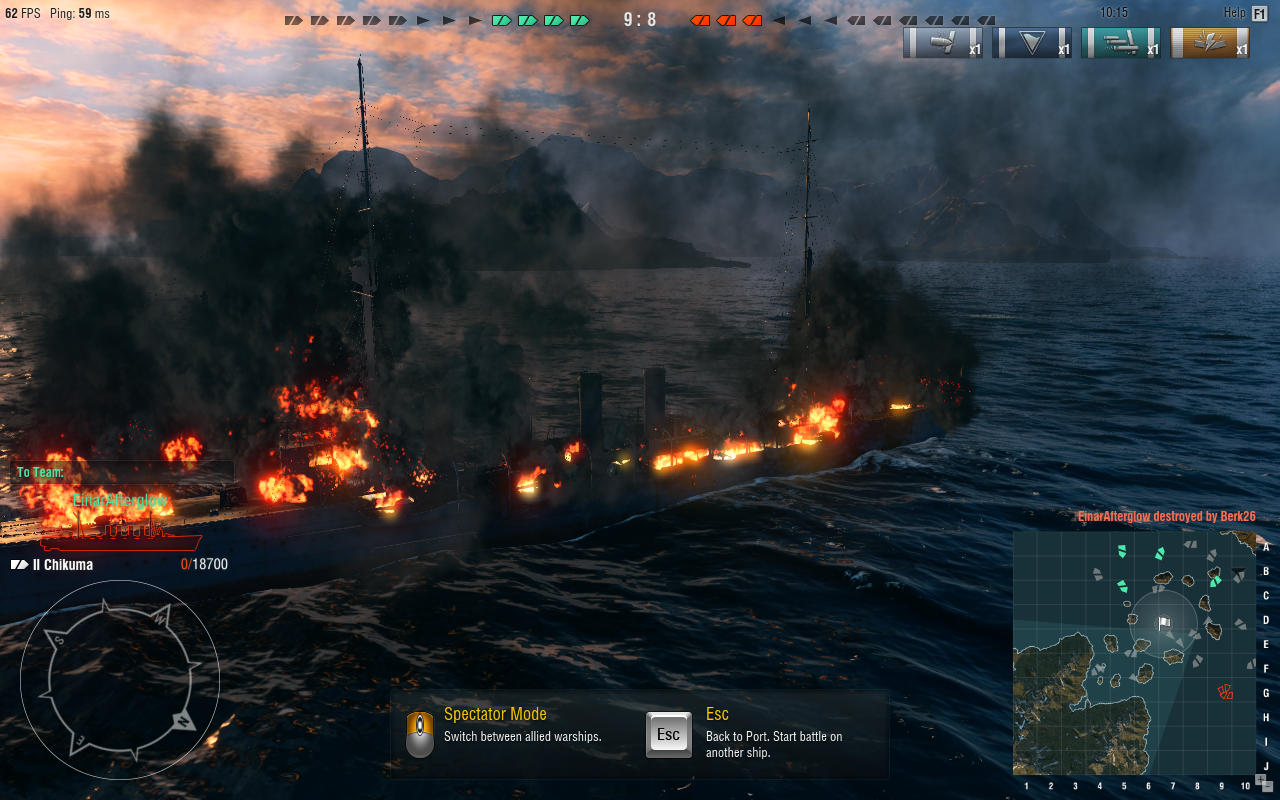
It's almost as much fun watching yourself explode.
It’s almost as much fun watching yourself explode.

Visually, the details of each ship really stands out. You can zoom out and in, and see even tiny details like deck plates on each ship. Water effects are solid, and explosions are vibrant and effective. Throughout each battle you are given both visual and audio cues to let you know your status, and any potential threats. Incoming fire and torpedoes are clearly identified, and warnings flash on your screen if you are on a collision course with one of the many small islands.

The only current struggle so far in closed beta, is the sometimes clunky match making system. Wait times can be long, and sometimes teams are very unbalanced either in tiers or total players. Though many of these issues are derived from the current amount of players in the closed beta. Overall however, the game seems to run smoothly even at the highest graphic settings, with only occasional lag and hiccups.

In it’s early state, World of Warships is looking to match the addictive nature of it’s predecessors. It offers a solid variety of gameplay options, and many ships for you to unlock and collect. With the premium options limited to a small variety of ships, and faster xp and in-game cash accumulation this should turn out to be another success.

Trove: Beta Review

Massive dungeons
A new dungeon to explore

Welcome to the colourful, voxel world of Trove. Trove, currently in open Beta is an exploration based, RPG building game. Sounds like a lot, and it is, but Trove pulls off this multitasking well.

Built around similar concepts to the ever popular Minecraft, Trove allows you to build might structures. This time however, rather than stone and wood, you use simple coloured blocks as your main building materials. Yes, there are ores and special blocks and artifacts to be found and mined to help build more detailed blocks for your castle or house, or mighty tower too. Trove however differs from Minecraft in many ways. Each zone you inhabitat, whether it be a player filled hub, or a dungeon filled adventure zone, allows you to port your constructed home with you wherever you go, and attach it to pre-determined home spaces in each area. These unique difference continue in most areas of the gameplay for Trove.

Trove environments
My new home

Where Minecraft’s basic survival mode tends to revolve around, well mining, Trove takes a different path here as well. Questing and exploring the various adventure zones and their differing biomes is the main ingredient to the fun of Trove. Each hub world contains various portals with varying difficulties that port you to these adventure zones. Here you will find many dungeons, ranging from small caves filled with skeletons, to massive, multi tiered tree house fortress among others. Combat in Trove is fun and fast paced, with attacks and skills you might more commonly see in MMORPG’s like WoW, or Final Fantasy Online.

Each player has the ability to switch between a great deal of different classes, from the basic Knight, to a Gunslinger, or a flying magical fairy, or even a Dragoon like fighter. The sheer amount of variety available to you is astounding. Enemies and items are also just as varied and amusing and are usually fun to fight.

So many choices
So many choices

The only aspect that doesn’t shine as much in Trove’s current build, is the multiplayer. Though most hub worlds are filled with people, as well as the adventure zones, there is rarely the need to partner with another player to complete quests. Assuming you are in a adventure area fit for your level, most of the enemies can be defeated easily so long as you don’t take on too many at once. It also tends to be a bit of a competition in adventure zones trying to beat others to the highly contested dungeons strewn across the map, though the map does at least tell you which dungeons have been recently cleared.

But otherwise Trove’s world is filled with colour and adventures to be found. Content has been regularly released and there is almost always something new to try when you log in, whether it be a new class, new items, or a new dungeon design. Trove offers a lot of fun for casual players, and enough detailed building materials for people with time and patience to build amazing structures to show off in their hub worlds, or in their own home world where they can invite people to join. All the character models and classes are just as colourful and varied and offer a wide range of play styles for all types of players.

Overall 8/10

The Forest, Early Access Review

Welcome to The Forest, a survival horror game from indie developer Endnight Games Ltd. The Forest puts in control of a survivor of a plane crash which lands on a mysterious island. Your first vision as you awaken in the wreck is that of some strange-looking man pulling your son from the wreckage and fading quickly into the distance. Your goal, survive and find your son.

The first few hours of The Forest generally consist of the usual survival game tropes. Find food, make fire and chop down a heck of a lot of trees. You can build various structures and traps, as well as farms with the components you find. Building larger structures like a cabin or tree house can take quite a long time as they require a great deal of resources to pull off.

As you explore the island, you begin to notice strange camps, and markers, and may even encounter some of the locals. A band of odd, cannibalistic mutants. Sometimes these mutants are hostile and attack you, other times they simply gather around your camp and watch you. Either way they are slightly disturbing, and nearly impossible to kill if you choose to try. They also demonstrate the key factor that earns The Forest its Early Access title. They are very buggy.

Check out this gameplay courtesy of TheNeoNerd

The game is interesting in its storyline, survive, find clues, then find your son. Unfortunately the random and consistent bugs and glitches deter from many of these activities. Beyond immortal mutants, it is easy to drop through the earth into an abyss, or get stuck underwater where no water exists.

Built with the Unity engine, the visuals are solid, but not spectacular. Environments are rich and full of detail, but character models are too smooth and shiny, and make them look like they are made of plastic. The fauna on the island is also limited to mostly rabbits and lizards. None pose a threat, and are simply added as easy sources of food for you to consume.

In its current early state The Forest is not as enjoyable as its premise would make it out to be. Though building and exploring can sometimes be fun and rewarding, the constant glitches and lack of a full story leave much for the developers to work on. Recently adding a multiplayer mode, and some bug fixes the developers at EndNight Games LTD. are trying to do just that. I hope to revisit The Forest when it is fully released to see how those improvements have affect the gameplay.

Overall 5.5/10

Medieval Engineers, Early Access Game Preview


Game Preview; Medieval Engineers

I recently got my hands on the early access release of Medieval Engineers, currently released by Keen Software House on Steam. Medieval Engineers is a voxel based, physics game, that allows you to build massive structures and mighty siege weapons using real to life engineering concepts.

Currently in early alpha, Medieval Engineers supports only a creative mode at the moment, but has a vast array of tools at your disposal for building mighty fortresses out of stone, or simple wooden homes. The game features realistic volume and physics. This means each block you place has weight and as you build higher that weight is transferred down through the layers to create load. You have to keep these factors in mind. You can’t simply build to the heavens without first thinking about structure and how you will support it as you go. By default these physics effects are live, so you have to consider each step in your build carefully, or see your walls crumble to the ground as you try to build a new level to your castle.

The real beauty in this game currently resides in this same destructibility. Poorly supported structures crumble in a fantastic effect as stones crumble to pieces, wood splinters and cracks and a cloud of dust arrises. It is sometimes just as fun destroying a beautiful castle as it was to meticulously build each step. Though at this stage of the alpha, the game engine is not yet optimized and this magnificent destruction sometimes leads to dropped frame rates and crashes. The developer team however is quick to update and fix, and is quite vocal in the community. With a quick submit option whenever there is a crash it really shows they want to get the game fully functional soon.

The engineering community so far has been able to create some amazing structures, though many of these take advantage of a few unintended effects currently in the game, the results are still beautiful with both historical as well as fantastical castles and cities rebuilt in scale precision. This creativity was best expressed as I climbed the many steps to the top of Minas Tirith from the Lord of The Rings trilogy.

Medieval Engineers
Holy s*@#!

The developers are very active, so the potential for creativity grows weekly. With teased multiplayer experiences coming in the future, great fortress battles should follow. New tools available regularly allow you to control even more of your environment and structures, even the sun. I am truly looking forward to more with Medieval Engineers whenever it achieves a state ready for final release.