The Universim continues it’s promising growth with an early access alpha showcasing some of the early game-play. Moving beyond the previously released tech demo, this early build brings many of the promises of the developers, Crytivo Games, to life.
It’s a small world afterall.
Though this early release is quite limited, it’s full to the brim with potential. After establishing your first early settlement, your people, or “nuggets” get set to work as assigned by you through the simple UI. Whether they start gathering food, stone, or start building and expanding is up to you. Each nugget can be assigned to these roles dynamically, and can be changed at any time depending on your current needs.
Your nuggets will go off to work, and require little attention from you. Though you are to decide where and when to build certain advanced structures, your nuggets in Universim will decide where new houses are going to be built, and where they will go to gather resources. This makes choosing your starting point very important so as to not have your nuggets wondering miles to collect wood or stone.
The dynamic planetary weather system is also key in your early decisions. Each planet has it’s own unique environment and weather patterns. A quick look at the available overlays will show you wind patterns, and temperature patterns to give you insight as to where to build. Cloud and storm systems will travel across the landscape dropping rain, snow and occasional lightning across the land. Placing your starting town in areas where storms are common, or where the temperatures drop greatly during the winter can be deadly early on. Crytivo also promises random events will litter the surface with earthquakes, storms, volcanoes and the such throughout your game.
Them’s storm clouds a brewin’
Your nuggets are also dynamic, and each have their own thoughts and emotions. In later game areas you’ll have to manage all of these aspects to keep a happy tribe together, and you can expect even more problematic issues coming up as you advance into the the modern age and expand across the planet surface. People in The Universim will live thier lives, grow old and die. As they age their stats will change to reflect this. Young Nuggets are fast on their feet and able to carry more produce around, but as they age they slow down, and carry little to nothing. Clicking on each one will show their stats and a quick biography of their family, and how many children they have.
Future depth to explore
A basic research tree is also available in this release, showcasing three trees of growth available to your society. There is nothing really new here as most of the early technologies are fairly straightforward and lead to more abilities and buildings. It will be interesting to see what direction The Universim goes with as you move into the modern and advanced ages.
Come, meet the family
This early build gives a great preview into the potential of The Universim. The game runs smoothly with a limited amount of bugs, and the groundwork has been laid well for the basic functions of the game. I’m really looking forward to the various additions forthcoming that will add more layers of challenge to the game. We haven’t seen a really great ‘God” game in awhile and they have always been one of my favorite genres. Crytivo games has their hands full with The Universim, but my early impression is that they are the right hands.
As always, thanks for reading, and be sure to share your comments below about The Universim. Make sure to subscribe to me on YouTube for future updates! Previous preview can be found here!
To get early access visit The Universim and opt in as an backer for immediate access to the Pre-Alpha build.
Space. The final frontier. What waits for us, out there? Awesome trading opportunities for us to make tons of cash of course! Welcome to Cosmonautica. A cute, funny, fairly solid game with a few issues that help it become just not that good. Release on July 31st this year, Cosmonautica does have a lot going for it, but struggles in a few areas that would make it a great, highly addictive game otherwise.
When you first load up Cosmonautica, your given the choice of following the story driven campaign, or the open world where you can do whatever you like with no linearity getting in the way. In either game mode however, you will take control of a small ship and head out in a mostly 2D adventure into space.
I gots trades!
At the beginning of either game, you’re given a ship and a lump of cash to get started off. Cash, or credits, are primarily used to buy upgrades to your ship, which come in the form of upgrade-able rooms that you can place throughout. Rooms range from basic living quarters, to washrooms, to medical and science facilities, and of course weapon rooms. You can place these rooms wherever there is adequate space in your ship, and get access to a side view cross section of your ship in order to due so. Beyond efficient space use however, there doesn’t’ seem to be any advantages or disadvantages to where you place these rooms.
Once your ship is prepped with the basic rooms, you need to hire crew to fill various roles on board. Pilots quicken your pace, and add maneuverability in combat, scientists conduct research and operate your shields, gunners shoot, and so on. Each of these classes generally have a room specified for their use, and though you can recruit them with the proper room, it’s pointless as they will be of little use and gain no experience. Experience levels your crew up, and gives them special skills, along with upgrading them with skill points which you can either assign to their main skill, or a random new skill to help fill out your ship’s needs.
What you’ll spend most of your time looking at
Regardless of whether you choose story mode or open world, you will primarily spend your time roaming from planet to planet. Each planet offers a randomized arrangement of trade able goods, missions and personnel to hire. Most of your early missions will have you transporting goods or people from planet to planet in an effort to make enough credits to upgrade your rooms, or ship entirely. All the missions are pretty straight forward, but do come with time limits, as each jump to another planet takes time and you need to balance your missions carefully with travel time. Take on too many missions may face you with heavy fines if you are not able to complete them in the given time.
Later on you’ll be able to engage in more dangerous missions like smuggling and combat. Smuggling missions are a simple act of making sure your tech, rooms and crew members are of high enough level to disguise whatever contraband you may have on board, and area really just deliver missions not unlike the other early quests. Combat missions however turn the game on it’s nose.
The local solar system
Entering into combat in Cosmonautica is almost game breaking. Battles are slow, long winded affairs. Ships are equipped with only a few weapons at most, and limited ammunition. There’s no phaser or laser fire here. You have limited maneuvering control of your ship, and are basically restricted to four flight patterns, circle around, fly by, collision course, or flee. None of these seem to work well however. You are also very limited by how much ammo you can store. These battle are long, really long and most will end with both ships running out of ammo, and you having to hail the other ship to settle terms. These terms generally ending up being 0 credits, and are really just time wasters. If I didn’t mention it before, battles are long, so long in fact during one occasion my crew actually went to sleep during battle, causing me to not be able to activate shields or fire my weapons, as both my scientist and gunner had gone to bed. The reward for the battle I eventually won was minimal and felt like a huge waste of time compared to the really lucrative option to earning credits, trade.
Yes, my gunner is sleeping in the middle of the fight
Trade in Cosmonautica is by far the easiest way to earn funds. Each planet has a list of exports and imports, and trade is as simple as taking advantage of low price exports, and trading them at planets that are in need of those same items as imports. Most of your time in Cosomnautica will be spent looking for deals, and adding cargo space to your hull in order to carry more goods. You will spend a lot of time trading, traveling and avoiding combat during your time with the game. Luckily a fast forward option is available for travel.
Story mode has you following a loose chain of linear missions revolving around your captain’s memory loss, and a mysterious box he was found with. Though the story is mostly well written and funny, once you get into the game, there’s never really a huge urge to continue on with the story, it’s usually more interesting to just try and build up your crew and ship as much as possible. There’s also no time limit to story missions, so no sense of urgency is ever given to complete them. There’s also no real choice as to how to proceed through the story outside of a few minor decisions, and it seems to waste the potential of the open galaxy environment.
Hi Lady!
Cosmonautica brings with it a lot of visual charm. The colorful, cartoon-like graphics are a lot of fun and there are tons of details throughout both your ship and the world to look at. As you travel from planet to planet, you get a side view of your ship to look at. Zooming in opens up the cross section view, and you can watch your crew busy at work, at play, or showering as needs be. It can be fun to watch this for a time, though generally you’ll find yourself fastforwarding and not paying them much attention.
Outside of this, there are several other mechanics at play. You’ll of course do research as you fly around, researching new rooms, and upgrades to existing rooms. You will also have to research the solar systems and galaxy to advance to new areas. There is also a needs simulation a la Sims that you need to address as you level up your crew members. Higher level crew members expect more, and you have to build the appropriate facilities or upgrades to keep them happy. Crew members also have traits which affect how they get along with other people. This can result in bonuses as happy crew members will catch fire and work more efficiently, or adversely go on strike and stop performing their duties. You’ll have to carefully balance your crew’s levels with the appropriate need fillers as you proceed.
Two of the three basic weapons you can buy
All of these factors give you a bit to juggle, but I never felt overwhelmed at any point. The game offers tons of helpful hints as you proceed, or you can choose to turn these off and figure it out for yourselves.
Terrible, terrible combat aside, there’s still a lot to enjoy about Cosmonautica. The trade system is well built, and it can be addictive trying to build up your crew and ship. The downside here however is there are limited choices as to what you can build, and how much you can upgrade them, meaning after awhile there isn’t much left to do except explore, or earn more credits. Hopefully the developers can address these downfalls in later updates, and especially work on the combat to make it more fun and interactive. Cosmonautica is available now on Steam, and is definitely worth a try if you are into space trading sims.
As always, thanks for reading, and be sure to comment and like below and let me know what you think of Cosmonautica.
Welcome to space. Fractured Space. Where massive capital ships duke it out over vast, asteroid filled maps. This tactical shooter is all about controlling these regions and taking out the other team before they can.
The first thing that will strike you about Fractured Space is the amazingly detailed ships. Each ship in the available three classes has an incomparable amount of detail. The lighting effects are especially good showcasing the ships precise design. Each ship is entirely unique, and easily recognised from a distance.
These ships are gorgeous
Of the three classes of ship there are large carriers equipped with a potential variety of fighters, fast support cruisers which can repair other ships, hunters which have a blink ability to outmaneuver the other ships. Each class, of course, has it’s own set of unique abilities, strengths and weaknesses to help you get an advantage over the other ships. Though these differences help each ship seem even more unique than their appearance, the actual abilities aren’t that unique from other similar games.
gameplay is similar to other recent beta’s like World of Warships. Teams start off on opposite sides of the map, and must race to control various flags or bases across the map. Each base captured adds experience for the controlling team, and gives you a place to retreat for cover and repairs. As you defeat enemies, or take over more bases, experienced gained advances you in level, and returning to a base upgrades your hit points and shields. Battle continues until one team can capture the opposing team’s home base.
These explosions are really dynamic
These battles are usually fairly quick affairs. The fights are often decided by rock, paper, scissor, as each class suits taking down another if piloted well. You need to be slightly ambidextrous to work with the default controls as well when they require much mutli-pressing buttons with one hand or the other. Once you get past this though, the short battles are still fun, but don’t always feel that tactical as you are generally just spamming the attack button and waiting for your special abilities to refresh. Though taking advantage of positioning does help some, the map is fairly open and generic. Ducking in and out of cover, or around asteroids doesn’t happen often, and battles quickly become more about numbers and accuracy.
After each battle, you gain experience used to obtain higher tiered ships and purchase new abilities for your current ships. These new ships add a bit more strategy to the combat with stealth features, long range attacks and the such which opens up new strategies and play styles.
Tech Tree!
Fractured Space is still in development, and I am sure these minor gripes will be worked out in time. Varied maps and effects would be great, but the overall gameplay is still quite good, and the ships themselves are really beautiful. I am looking forward to coming back to this game upon release the see the new features and available ships.
As always, please comment and like below, let me know what you think of Fractured Space.
For my preview of World of Warships head here next!
Another week, another Rewind Review! This one just barely qualifies having been released way back in 2013! Back way before the flying cars, insta cleaning clothes, and weather control that Back to the Future II promised us this year. Though it’s not as old as some of the other games I have featured so far, this is still a great game to pickup on play if you get the chance.
A 2D tactical RPG, Skulls of the Shogun takes inspiration from other classic games like Final Fantasy Tactics, and Advance Wars. Taking place in a colorful cartoon world, Skulls of the Shogun takes this inspiration and rolls with it in all sorts of fun and intuitive ways.
Getting the lay of the land
Set in ancient Japan, you take the role of a recently deceased Shogun. Killed by his own lieutenant during battle, he is relegated to the afterlife as a skeleton. Faced with waiting in line with thousands of other fallen soldiers to the end of time waiting to get into the afterlife, the general instead decides to take matters into his own hands and raises an army to push his way to his rightful reward.
The playful art style mixes well with the almost constant shade of humour in the game. Dialogue and character choices are both funny, and light hearted. The third wall is broken often as the characters question not only the game mechanics, but the player’s actions. This cleverness tends to fade a little as the game proceeds, but not so much that it isn’t still funny at times.
You got that right buddy!
Each character class has a unique look and animations. The only fault visually is occasionally the screen becomes crowded with units and objects and it can be difficult to pick out the object you want, though the game does try to assist with a pop up when several items are selected close together.
Each battle is a 1v1 turn based affair. The game starts you out with very basic commands and units and does a good job of dishing out new elements with each new battle. Every different unit comes with it’s own stats and abilities. Infantry have solid defence and good knockback, but are slow and don’t deal that much damage. Calvary have long movement range and high attack, but no knockback. There are various other units like archers and magic casters to fill out the ranks. Your general is also controllable in battle and gains new abilities as the story progresses.
I’m a beast!…. errr Demon…
Each of these units can be upgraded during any single battle in the unique manner of eating the skulls of fallen foes, even though as they will tell you themselves, it’s pretty gross. Each skull adds hit points to your units including your general, and when 3 skulls are consumed your unit becomes a demon and gains an extra action each turn. This extra action can be extremely useful in most battles. Along the way you will also find various potions and power ups to assist you in winning.
On later maps you will also be tasked with some minor resource management. Rice paddies can be conquered to give you rice to pay for new troops at barracks. There are also other buildings to be conquered to give you access to more powerful units. Rice paddies are limited, and each one including the other buildings can be conquered by the opposing force at any time. Controlling the map becomes very important on these levels.
Just a little exposition
Each map has different objectives, and several can be won in different ways. Defeating the enemy general, defeating all troops, or moving a unit to a specific marker may all be ways to win. Several maps have multiple stages and differing objectives in each stage. This with the overlapping humour keeps the game fresh and fun throughout.
This is a fun game with a long campaign, multiplayer options and a ton of laughs. With a regular price of $10.99 on Steam it’s definitely a bargain, and will fill up hours of your time. If you are a fan of strategy games, good humour and want a game that is easy to get into, this is a great one for you.
As always, if like this review, or have played the game, make sure to like and comment below, and be sure to follow me on Twitter!
Missed last weeks Rewind Review? You can catch it here!
Planetary Annihilation, a game just a few key items away from being very solid. Released last fall as a full release game, Planetary Annihilation was developed by Uber Entertainment. Styled after other similar real time strategy games like Supreme Commander or Total Annihilation, Planetary Annihilation gives you a chance to control a large group of units on a global scale. With a regular release price tag of $32.99 on Steam, I got Planetary Annihilation expecting a solid, polished game, unfortunately, I got something else entirely.
My first attempts to launch into the game to test the basic mechanics and get used to the controls created a frustrating experience. After several crashes, and various game breaking bugs, I found myself on a barren planet, with little idea of what to do. Being very used to other RTS games, I did manage to figure my way through the basic gameplay once the initial bugs were conquered.
Okay, now what?
What I found after this layer of stress, was a fairly run of the mill top down strategy game. As with most RTS you are dealt out a basic construction unit that can build various base structures like factories, energy providers, and resource collectors. Similar to Supreme Commander, Planetary Annihilation has you balancing two resources in energy, and metal. Though in my time with the latter, these resources seemed fairly easy to manage, and never really felt like they were restricting me from building what I wanted. This only really changed after my AI opponent managed to destroy some of my facilities far off from my main base.
This is where the one unique area comes into play in the game. Instead of a flat environment, combat here takes place on a full 3D planet. This adds an interesting element as late in the game, when your units are spread across the planet, it becomes an interesting challenge keeping view of all the different battles which may commence on opposite poles of the planet.
Your bases and units can take up quite a bit of space
These battles can quickly become quite large scale across the planet as resources are spread out randomly on each map. Units can engage on the ground, in the air or across the seas and lakes on each planet. The units at play however, are all fairly usual, and don’t offer much unique gameplay. Combat is basically rock paper scissors, as each unit generally fairs best against one other type, and struggles against the rest.
Planetary Annihilation also features a top down galaxy map where you can travel from planet to plane to unlock technologies, or engage enemies in planetary combat. Battles can take place over multiple planets and their moons, with hundreds of units at play at any time. Late game mechanics add devastating mines, nukes, and even asteroids that can destroy whole planets. Though these features are fun, getting through the early, very mundane combat and the various bugs and glitches can be a challenge even for the most patient of gamers.
Environments range from pretty, to pretty bland.
Though there remains a great deal of potential and challenge here, the fairly straightforward gameplay, lack of any real tutorial and unfinished feel of Planetary Annihilation don’t add up to the large price tag. Classic games like Total Annihilation and Supreme Commander sill offer more depth and playability than the current offering from Uber Entertainment.
If you like this review, leave a comment or like below. Also, check out my review for Valiant Hearts!
As a regular feature to the blog, I will be looking back at some of my favourite games from the past. Come and join me as I relive some of these classics, and some of the other more obscure games I’ve come across over the past 30 years!
From Dust brings the term sandbox game into a whole new meaning. You are literally dropped into a giant side box. A sandbox that you can control and manipulate in order to help your tribesmen find the promised land. Developed by Ubisoft, and release in August of 2011. From Dust gives you god like powers over the elements.
The premise here is simple. With your various powers over the sand, wind, water and fire, guide your tribe from totem to totem in order to unlock a portal to the next zone. Each level gradually introduces you to new powers and concepts. The first few levels are pretty straight forward and act as tutorials to help you develop an understanding for the game’s basic mechanics and controls. You can literally take your godly hand and scoop up areas of terrain, or water, or even lava to mold and manipulate the land.
Maybe I should build a castle in the sand?
As you proceed farther into the game, these powers are used not only to lead your tribe forward, but also to protect them from the earth itself. Whether it’s fire, floods, giant waves or massive eruptions, you must continually alter the earth in order to keep your tribe safe. This is where the interaction of the various powers comes to fruition. Though sand can be piled up and prevent waves of water from flooding the area, the force of the water can eventually erode the sand away. Combining lava and sand can create rock to solve this problem, but accidentally redirecting lava in the wrong direction can be even deadlier.
This balance of powers, and the addition of various power ups as well map unique quantities like hidden underground springs and other surprises keep you adapting often. The maps often adapt as well. Several levels in From Dust change part way through and throw new obstacles your way. In a first play through these events create greater challenges as now your well planned out modifications to the world need to quickly be changed before your tribe is flooded, or burned alive.
Are we powerful, or is it powerful?
The look and feel of the earth and it’s elements is also just a lot of fun to play with. Terraforming the earth with your various powers is intuitive and the elements react in fairly realistic way. Water and lava combine into clouds of steam, cooling into ever growing mounds of rock. Rivers slowly cut their way through sand at the lowest points creating rivers and peninsulas. It’s truly a wonder to just play in the sandbox that is From Dust just to see what will happen.
Is this the end, or the beginning?
Throughout all this, a charming story of the cycle of life unfolds. From Dust is definitely a game you want to give a full play through of to gain the full experience. The beautiful graphics and physics hold up today against more modern games. The story, though a relatively simple one of life and death is told mostly visually as you proceed from level to level. This is a great game, and a gem to try if you have a chance.
From Dust is currently available on Steam for $14.99
Check back next week for another Review Rewind! And don’t forget to comment, and share below.
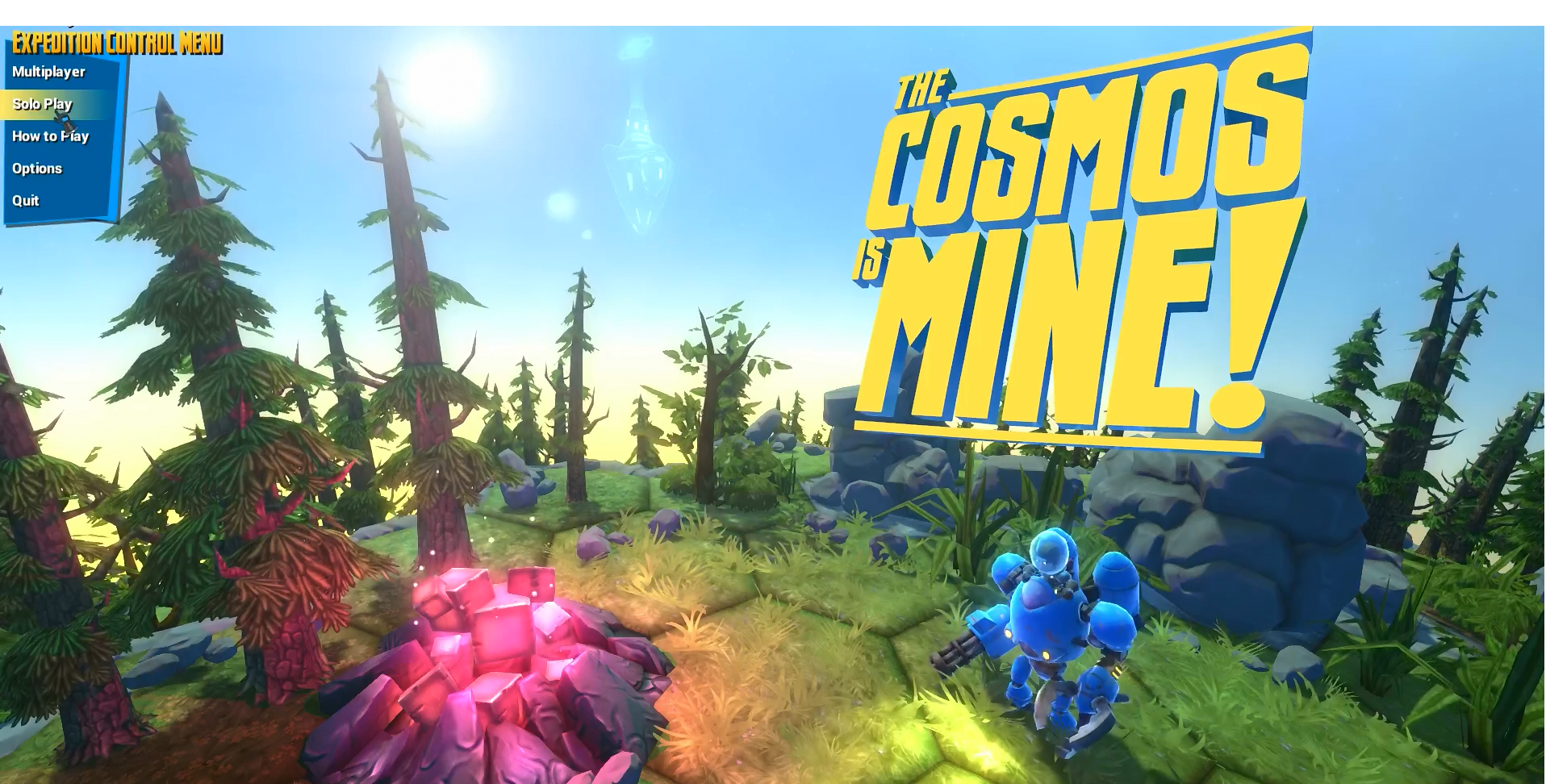
TransOrbital miner license? Sense of adventure? If you said yes to both of these questions you are perfect for The Cosmos is Mine!, a real time strategy game from Playcorp. A small Australian developer focusing primarily on strategy games. The Cosmos is MINE! is a real time strategy game focused on zone control and resource collection.
Dropping you onto a small 3D planet, The Cosmos is Mine! tasks you with competing against other players for the valuable resource of Animus. The hexagon based maps though seemingly small, are full of detail and various biomes. Mountains, lakes, forests, and frozen hills cover the landscapes to give each planet a unique look and feel. The game takes advantage of the unique 3D environment to affect game play. Line of sight and the various defence towers gain advantages based on their elevation. Units slow down, or must find new routes to get into zones due to impassable mountains or other obstacles like the oceans.
The world is mine!
The current gameplay is simplified with 4 distinct units. The engineer builds towers and mining facilities. The prospector scouts ahead and can capture new zones and bases. You can engage other players in combat with the assault class, or the artillery class. Each class is upgradeable via some of the excess Animus you collect. You must take advantage of each unit, along with the various defensive towers to control zones on each map, as well as guard your Animus collectors. Every few minutes of a match you are required to reach a certain quota of Animus in order to keep your license and stay in the game. This mechanic forces you to play a balanced game of attack and defend so as not to miss your quotas as they arrive.
Though you can play a solo campaign, it’s doubtful you will do so more than once to get your bearings. The multiplayer is where the fun is here. Currently only 1v1 and 2v2 game types are available. The 1v1’s have you pushing to quickly get as many zones as possible, or cut off your opponent before he can do the same. 2v2’s on the other hand are hectic affairs as the maps feel small and you must quickly react and work together to avoid being double teamed and watch your quotas be missed.
So much to learn
Though the current build of The Cosmos is MINE! feels like it lacks a little bit of content, what’s here works well. The environments are lively and interesting. The learning curve is very low, and it doesn’t take long to get into the game. There is a great deal of room here to add some more units with differing abilities, and possibly planetary effects that can impact gameplay. The main concern here is how to add the type of content that will keep players coming back to play over and over again.
I recently checked out the early visual prototype for The Universim. Universim is a god-like civilization builder in the mold of the Populous games. Brought to us by indie developer Crytivo Games, Universim is still in pre-alpha. Though the prototype is a visual format only, and doesn’t give us any real functionality yet, it does give us a good idea of the scale and overall look the developers are going for.
The starter “Mother Earth” planet you begin on shows off several biomes. These basic environments range from grassy fields, to massive rocky mountains, vast oceans and forested areas. It also gives you a rough idea of the range of tech you will have at your disposal. From small tribes, to farms, to giant skyscraper filled cities, the plan to allow you to build a society up to the advanced stages of space flight is also evident.
Like most god-like games, the planned gameplay revolves around your interaction with the native people of each planet you may visit. The Universim plans to add more dynamic abilities by leaving these societies growth completely to the AI, and although you will be able to affect environments and events, you will not be able to control people directly. This should add a level of unknown to the game, as actions you take may often not have the results you intend. This will be balanced with a “Wrath” meter, which will fill up as you take actions, and allow you to reign down destruction on your people when they decide to take actions you disagree with.
The developers at Crytivo games have bold plans for The Universim. Colonization will be a key factor with The Universim. You will be able to send ships to other planets in the universe and build new habitats for your people. With random generated planets a lot of care and planning will have to go into each colony, as varying weather and environment effects will give your people new challenges with each planet you encounter.
With the crowdfunding effort for The Universim still on going, I am looking forward to seeing how far the devs are able to go in their quest for rejuvenating the god-like genre with their new concepts.
I have just spent several hours with Boid, a simplistic 2D RTS that has you take control of several amoeba like organisms in underwater cavernous environments and pits you against an equal foe located on the other side of the map. Brought to us by indie developer tinyBuild Games, also known for the satrical “No Time To Explain”.
The idea is simple, take over all control points on the map before your opponent can. Control points are broken into two basic categories, spawn points that slowly spawn new troops up to a maximum of five at a time, and evolution points which allow you to morph your creatures into various upgraded forms, like a strong crab like creature, a long range laser canon, and speedy scouts among other variations. You are tasked with controlling your flow of new units while strategically choosing which path to take and which upgrades to use and balance everything accordingly. All actions are controlled by a simple click of the mouse, and a side panel gives you a brief summary of units available, and selected, and you can use waypoints to help automate some of your troops to specific defense points or upgrades to capture.
Both offline and online modes are already included in the most recent build. The offline version features a fairly good A.I. which can challenge new comers to the game and is a good way of getting acquainted with most of the unit types, and general gameplay. Multiplayer of course is where a game like this shines, as adapting to a human player’s differing strategies and changes of pace are where the real challenge and fun is. With the recent addition of leagues, and ranked play, you can easily lose hours to Boid.
Graphically Boid’s 2D graphics are simple, yet colourful and make it easy to identify unit types by their shape, as well as identify enemies. Winning and losing spawn points is shown graphically by quick flashes of light on the screen to give you a quick clue that you may need to investigate elsewhere. The submerged aquatic setting is full of life, and the lighting effects give great depth on what is otherwise a flat world.
Available now on the Steam Early Access program at a measly $3.29 CAD, Boid is a steal for anyone looking for an easy to pick up, but competitive RTS. One that is being well supported by the developer with regular updates and improvements.





 MicBeMac Games