Early Access Review: The Bug Butcher

Do you like fast, addicting and extremely challenging arcade shooters like we had in the 80’s?  Then The Bug Butcher is definitely one to check out.  Currently available on Steam Early Access, The Bug Butcher is developed by the indie team at Awfully Nice Studios.

The Bug Butcher is a classic arcade style shoot up action game that challenges you to blow up bizarre alien bugs.  The developers have been putting a ton of work into the cartoon art style and terribly funny dialogue.

The Bug Butcher

You first meet our hero as he arrives at a giant factory of sorts, where horrible alien space bugs have taken over the plant.  Running through the first few tutorial levels has you meet one of the factory workers, who appears to look a little like a talking Gameboy.  The dialogue and story are clever and funny, and the exposition provided by your guide is often scoffed about by the protagonist, due to it’s completely satirical nature.

These first few moments set you up for the initial extremely addicting gameplay.  Dropping you through one room at a time, you must fire your gun upwards as the alien bugs drop from the ceiling and other areas, and bounce around the screen.  Each bug has unique skills and properties and you have to adapt to each as they fall from above.  Killing them earns you coins, and a score multiplier to rack up the points after each kill.  Every level has three to four waves of creatures before you can proceed to the next level, and of course, there is a time limit applied that you must beat.  As you are only able to shoot straight up, and can’t jump, each shot has to be well timed as you avoid your bouncing enemies.

The Bug Butcher

As the levels progress you’re given a variety of powerups to use, that either increase your speed, power of your gun or give you temporary new weapons that cause mass destruction across the screen. These weapons can range from homing rockets, to a powerful laser that disintegrates everything, a gatling gun that fires at a high rate but needs to be charged, or a electric gun that on a successful hit jumps to other foes.  After enough kills you’ll also gain a special attack with a variety of effects.  You can fire off more rockets, freeze everything on the screen, or even gain temporary invincibility and speed.  You’ll need to use them all if you’re going to survive the later levels.

The Bug butcher
Eww, slime. Gross.

Difficulty ramps up fast in The Bug Butcher.  Every level introduces new enemies.  Some are explained but others come out as a surprise and you’ll have to quickly react to their new abilities and patterns.  At some points there are so many different foes on the screen it becomes almost impossible to survive as you try to dodge and take out the most dangerous enemies first.  Gameplay is broken up even more with elevator levels that take away some of your weapon drops, or other levels with various moving platforms or force fields that redirect your enemies bouncing and can either be a boon or a burden depending on what  you are dealing with at each moment.

The soundtrack keeps up with the action throughout, and gets your blood flowing.  The up beat electronic music really brings me back to my retro roots, and hours spent at the arcade, or in similar games on late consoles.  The music really keeps you on pace and meshes well with the chaos on the screen.

The bug butcher
And this is just the first zone.

Throughout all these busy levels, the gameplay doesn’t miss a beat.  I rarely saw my FPS drop below 60 regardless of how many enemies were on the screen.  It remained smooth and fast, aiding in the overly addictive nature of the game.  Frustrating death after frustrating death couldn’t keep me from giving it one more go, or trying out the next level.  Each successful level rewards you with a star rating, and comparison to your steam friends and the overal rankings.  You’ll also get new weapon drops as you go, as the game is really good at introducing something new with almost every level.

With competitive local multiplayer support planned, players are sure to have tense competitive battles with their friends shortly.  We can only hope that developer Awfully Nice Studios also has online multiplayer planned in a later update to really create a gem of fun gaming here.  The Bug Butcher is currently available on Steam for $10.99.

As always, thanks for reading, and be sure to comment below and let me know if you have had a chance to play The Bug Butcher yet.  Follow the developer @_AwfullyNice_ on Twitter for more updates.

Check out another great indie review: Subnautica.


Ark: Survival Evolved: Early Access Preview #1

Want to go epic?  Go Ark:  Survival Evolved.  One of the more recent entries into the survival genre, Ark: Survival Evolved brings one of the more polished early release titles to the fray.  This game of “large” adventure was developed by Wildcard, and is currently available on Steam in Early Access form.

Ark: Survival Evolved
I’m so pretty!

Like most games of the it’s like, Ark drops you into the thick of things, naked and alone, with only your fists to serve you along the way.  At first though, you’ll notice the incredible visuals.  Assuming of course your system can handle them.

On Epic graphics, Ark is beautiful.  The land is detailed and full of texture.  Water ripples against the wind, and the various weather affects set in quite realistically.  The sky ranges from clear, to overcast, to raining.  Fog rolls in amongst the valleys and hills.  In turn these effects also hinder your character in adverse ways.  Sunny days raise the temperature and cause you to over heat, where adversely the rain cools you off.   This is not to say of course that the visuals are perfect, this work in progress game is full of visual bugs and faults.  There are various clipping issues resulting in hilarious finds with creatures sticking out of walls or hills, or looking kind of obscene as they press up against each other in all the wrong ways.  There are also the whacky fun time trees that turn 2 dimensional and start waving frantically across your screen.

Though these small faults are funny and sometimes a nuisance they don’t break the game in anyway, and allow you to enjoy the unique survival aspects.  When you spawn you are treated immediately to the various prehistoric lifeforms.  There’s a fairly good amount of variety here with various types of dinosaurs wandering around.  For the most part these creatures are scaled fairly realistically and add to the Jurassic Park awe of seeing all these long extinct creatures go about their daily routines.

Ark: Survival Evolved
Hello little guy, wait why is the Theme to Jurassic Park playing?

The world is fully alive, and interacts not only with the player, but with itself.  Raptors roam the jungle, taking down prey in packs.  Sabertooths fight mammoths on the frozen hill sides.  The occasional Tyrannosaurus Rex might pop up and try to take out a Brontosaurus.   All of these NPC creatures act more or less as they should, and will react to the player’s presense around them.  Though the various herbivores will generally ignore you, don’t get too crazy and steal a stegosaurus egg and expect not to get chased down by angry parents.

The character creator is also fully purposed and allows you to create a wide variety of character looks.  From the normal, to the sublime to the outright weird.  You have a lot of control over how your character is going to look.  This means there are a lot of ugly characters out there unfortunately.

Optimization on all these graphics is still a work in process, and can vary from server to server once you add in lag and latency issues on top.  This can be a major detractor on the very full official servers, but can be avoided by finding a smaller unofficial server where the lag can be avoided.

That covers the look and feel of Ark: Survival Evolved, stay tuned in a couple of days when I dive into the gameplay and more detailed features of the game.

As always, don’t forget to comment, and like below, and let me know how your experience with Ark:Survival Evolved has been.

For amazing gameplay videos of Ark, check out The Neo Nerd, and The Flying Squirrel Girl on Youtube now!


Subnautica: Early Access Review

Tired of punching trees and looking for rocks to build a campfire?  Then Subnautica is the survival game for you.  Subnautica throws you into a vast ocean full of dangers and mystery and tasks you with not only surviving, but finding out what went wrong to get you stranded there.

Subanautica
Well it could be worse…

As seemingly the sole survivor of your terraforming mission after an explosion sends your craft on a collision course into a planet with an endless ocean, Subnautica’s first objective is survival.  Like most survival games, you must quickly find resources to help you stay alive in the game’s varied environments.  The trick with Subnautica is that all of these environments are submerged which adds a unique twist to the genre.  Not only are you managing the usual things like thirst and hunger, you are also limited at first by your capability to carry an air supply below the surface.  This adds an extra layer of danger to your chances as each dive could be your last if you don’t time everything right.

Subnautica does a good job early on with making things seem both familiar but very alien all at once.  Set in the far future with advanced technology that can craft items in seconds with a fabricator, you are still made quite familiar with the basic components needed to craft these high tech items.  Throughout the ocean environments you will find various of these resources strewn about on the ocean floor, lime deposits holding various metals and minerals, salt deposits, corral, and other useful flora, and of course fish.

Subnautica
The beautiful sunset…

The animals of the ocean are where the alien concept of the planet first shows it’s colours.  The fauna of the planet are incredibly diverse and alien like.  They vary from small and fast fish, and uniquely useful Airsacks, which are very useful early on, and quite harmless, to large predators you need to avoid, to small exploding fish, to massive whale like creatures so big and slow corral has formed on their backs.  The fauna AI ranges from passive, to very aggressive, and the day and night cycle affects this nature as well.  Fishing for small fish at night for example may have you find several sleeping and easy to catch.

Once basic survival is covered, advanced resources like titanium and silicone will allow you to build both structures and vehicles.  As most materials can be very rare, with enough patience you can build underwater craft, and even submarines to help you search the ocean bottom.  Surviving long term means manufacturing parts to build your own underwater base via  a network of tube parts that you can connect together, and even draw oxygen to from the surface.   Later equipment even allows you to terraform the environment to you liking, or dig holes through ocean floor.

All the while in the distance stands the ship you arrived in, the Aurora, where the yet to be completed end game seemingly will exist.  Surrounded by radiation, and protected by massive mutated squid like creatures, the Aurora plays an integral part in the gameplay.  Not only is the ship filled with various high tech components to be grabbed once you have the right tools to do so, but it also affects the nearby environment.  The various radiation leaks in the craft result in regular explosions, which litter the ocean with components and larger explorable pieces of the Aurora where various components can be found.  It also seems like a bad idea to be too close to the Aurora when one of these explosions occurs.

subnautica
Oh, my bad, things can get worse

It looks like we still have a bit of a wait to see what mysterious affect brought down the Aurora, but there is still enough here in Subnautica to keep most people busy for several hours.  The potential for some type of end game in the survival genre is always a welcome feature as it sets goals for the player to reach, rather than have them simply build bigger and better structures to ease their survival.  Thought the environments are well built and colorful, they do sometimes still lack some life, as several areas are not well filled with lifeforms.  Generally each area has but a handful of fish floating around at any time, and I have yet to encounter huge school of fish, or any bottom dwelling creatures crawling around to add variety.  These will all hopefully be things we see added in upcoming updates.

subnautica
Crafting in style

Available now in Early Access, Subnautica adds a fresher flavour to the somewhat overfull survival genre.  With colorful graphics and environments, and a unique survival protocol taking place almost entirely underwater, this game is a  lot of fun.  Though the game still lacks some content, regular features are added, and with a potential end game in store there is a lot to explore here.

Want more?  Check out Stranded Deep!  Don’t forget to comment and like below, let me know what you thought of Subnautica. 

The Cosmos is MINE!: Early Access Review

The Cosmos are MINE!

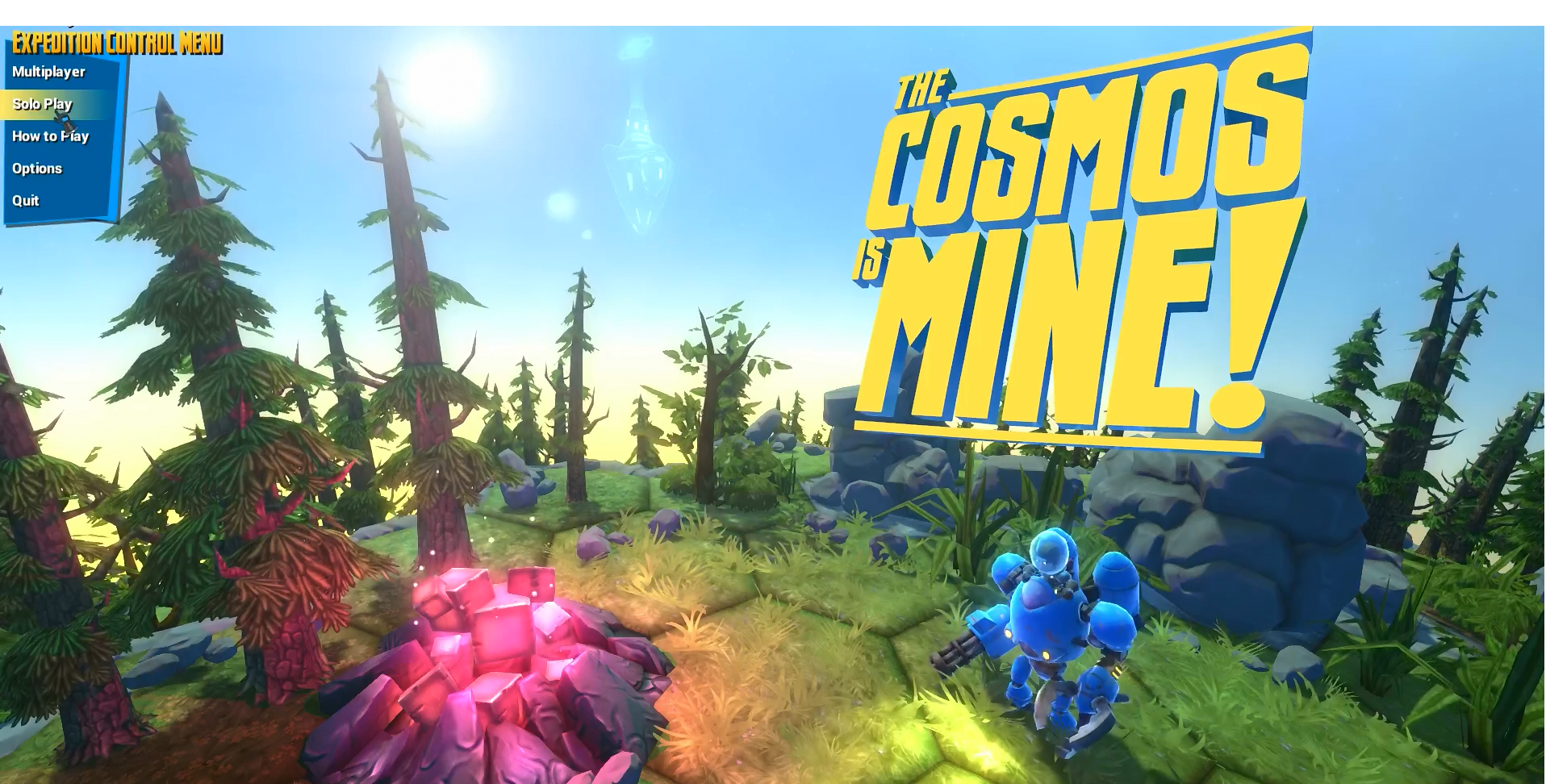
TransOrbital miner license?  Sense of adventure?   If you said yes to both of these questions you are perfect for The Cosmos is Mine!, a real time strategy game from Playcorp.  A small Australian developer focusing primarily on strategy games.  The Cosmos is MINE! is a real time strategy game focused on zone control and resource collection.

Dropping you onto a small 3D planet, The Cosmos is Mine! tasks you with competing against other players for the valuable resource of Animus.  The hexagon based maps though seemingly small, are full of detail and various biomes.  Mountains, lakes, forests, and frozen hills cover the landscapes to give each planet a unique look and feel.  The game takes advantage of the unique 3D environment to affect game play.  Line of sight and the various defence towers gain advantages based on their elevation.  Units slow down, or must find new routes to get into zones due to impassable mountains or other obstacles like the oceans.

The Cosmos
The world is mine!

The current gameplay is simplified with 4 distinct units.  The engineer builds towers and mining facilities.  The prospector scouts ahead and can capture new zones and bases.  You can engage other players in combat with the assault class, or the artillery class.  Each class is upgradeable via some of the excess Animus you collect.  You must take advantage of each unit, along with the various defensive towers to control zones on each map, as well as guard your Animus collectors.  Every few minutes of a match you are required to reach a certain quota of Animus in order to keep your license and stay in the game.  This mechanic forces you to play a balanced game of attack and defend so as not to miss your quotas as they arrive.

Though you can play a solo campaign, it’s doubtful you will do so more than once to get your bearings.  The multiplayer is where the fun is here.  Currently only 1v1 and 2v2 game types are available.  The 1v1’s have you pushing to quickly get as many zones as possible, or cut off your opponent before he can do the same.  2v2’s on the other hand are hectic affairs as the maps feel small and you must quickly react and work together to avoid being double teamed and watch your quotas be missed.

The Cosmos
So much to learn

Though the current build of The Cosmos is MINE! feels like it lacks a little bit of content, what’s here works well.  The environments are lively and interesting.  The learning curve is very low, and it doesn’t take long to get into the game.  There is a great deal of room here to add some more units with differing abilities, and possibly planetary effects that can impact gameplay.   The main concern here is how to add the type of content that will keep players coming back to play over and over again.

Overall: 6.5/10

The Cosmos is MINE! is currently available on Steam Early Access

IGN members can also get the game free this month with their membership.

For a similar game, check out my preview of The Universim


Medieval Engineers, Early Access Game Preview


Game Preview; Medieval Engineers

I recently got my hands on the early access release of Medieval Engineers, currently released by Keen Software House on Steam. Medieval Engineers is a voxel based, physics game, that allows you to build massive structures and mighty siege weapons using real to life engineering concepts.

Currently in early alpha, Medieval Engineers supports only a creative mode at the moment, but has a vast array of tools at your disposal for building mighty fortresses out of stone, or simple wooden homes. The game features realistic volume and physics. This means each block you place has weight and as you build higher that weight is transferred down through the layers to create load. You have to keep these factors in mind. You can’t simply build to the heavens without first thinking about structure and how you will support it as you go. By default these physics effects are live, so you have to consider each step in your build carefully, or see your walls crumble to the ground as you try to build a new level to your castle.

The real beauty in this game currently resides in this same destructibility. Poorly supported structures crumble in a fantastic effect as stones crumble to pieces, wood splinters and cracks and a cloud of dust arrises. It is sometimes just as fun destroying a beautiful castle as it was to meticulously build each step. Though at this stage of the alpha, the game engine is not yet optimized and this magnificent destruction sometimes leads to dropped frame rates and crashes. The developer team however is quick to update and fix, and is quite vocal in the community. With a quick submit option whenever there is a crash it really shows they want to get the game fully functional soon.

The engineering community so far has been able to create some amazing structures, though many of these take advantage of a few unintended effects currently in the game, the results are still beautiful with both historical as well as fantastical castles and cities rebuilt in scale precision. This creativity was best expressed as I climbed the many steps to the top of Minas Tirith from the Lord of The Rings trilogy.

Medieval Engineers
Holy s*@#!

The developers are very active, so the potential for creativity grows weekly. With teased multiplayer experiences coming in the future, great fortress battles should follow. New tools available regularly allow you to control even more of your environment and structures, even the sun. I am truly looking forward to more with Medieval Engineers whenever it achieves a state ready for final release.

Besiege: Early Access Review

If destruction, fire, and the occasional crushed sheep is your thing, Besiege is the game for you. Currently released in early access on Steam, Besiege is a physics based building game that allows you to build powerful siege engines to lay waste to the massive fortresses, tiny hamlets, and yes, unsuspecting sheep.

Developed by Spiderling Games, Besiege is a tinkerer’s play box. It drops you on a map with a clear set of goals, and lets you create whatever your mind can come up with to meet those goals. Currently limited to a series of tutorial maps, these goals can range from simple destroy missions, where you must destroy a certain percentage of the environment or troops on the screen, to obstacle courses and resource collection courses.

Not unlike opening a box of your favourite Lego as a child, Besiege gives you a variety of tools and equipment to build your creations. You need to figure out the right combination of components and moving parts to get the job done, and there are always multiple possibilities for each encounter. One early level for instance tasks you with destroying a tower located on a mountain, you can do so by rigging together some springs and pulleys and ropes to create a catapult or trebuchet, or maybe create a legged monstrosity to climb the mountain side, or a flying bomber that can rain hell from above. Your choices are limited only by your imagination and ability to take advantage of the game’s sometimes finicky physics engine.

The game also currently includes a sand box mode, which acts as a test ground for various designs with a variety of obstacles and targets to test your machines on. The real fun however is in the mission play and trying to figure out new ways to destroy your targets.

The visuals for the game, are cartoonish, and comedic, with massive explosions throwing debris across the map, or throwing soldiers up past the camera. Sheep splatter into satisfying pools of blood as your siege engines crush tme with spikes, bombs, and fiery balls of death.

With a quickly growing community of siege designers, a variety of both monstrous, and incredibly well thought out creations are also available to be shared and used in your own game, and each design can still be altered or improved for your own tastes. Individual components can also be redesigned and their effects changed to serve varying purposes, like increasing the tension on a spring, or the rotation speed of a wheel.

Though the structured mission play is currently limited to only one zone, with all of the bits and pieces available in the steadily increasing inventory, it’s not hard to find new and more inventive ways to cause havoc on each map. Besiege has shown a good start to a very creative game that you can spend minutes on, or hours trying to create that perfect weapon of destruction, or a perfectly balance flying contraption.

Overall 6.5/10

Streaming? Into the future…?

With Nvidia recently announcing its foray into the console business in this article on IGN.com, with it’s release of the Shield console, featuring their game streaming service The Grid, I began to think about the past of physical media and the potential future of how we may be gaming in the near future.

Before the advent of affordable compact disk drives, we gamers were all quite used to a massive case of floppy drives, be they 5 1/4 or 3 1/2, we knew we’d be spending potentially hours with installing larger games onto our PC’s with multiple disk changes along the way, and heaven forbid any of them ever got scratched! Our hearts would sink, and we’d scramble to see if a friend had a copy of the install disks so we could start over. Console gamers faired a little easier, with their mostly less bulky cartridges in over sized plastic cases. We would figure out ways to stuff a dozen of them inside a knapsack with our consoles to bring to our friends. In general we avoided magnets and spills, and hoped the batteries in the cartridges didn’t die and delete all of our saves.

Obviously gaming media has evolved over the years, from those very disks, and cartridges, to compact disks with their own accomplishments of getting to that next disk in big games like Final Fantasy VII for example, and dvd’s and then Blu-Rays. Able to store more and more information with each evolution and become more durable as well. One of the last steps being the direct download. Imagine, no media at all. You don’t even have to step from your home to the store, or mailbox to get your game, just click the link and wait till it’s nested itself on your hard drive, ready to install. The real reflection however is how the technology has mirrored the general need in current society for more and more immediate gratification. Enter streaming.

Now there is no longer a need for media, even your hard drive needs minimal space, click the link, start playing, and hope there is no lag. So how does this effect the industry as a whole? We already know that more and more publishers have gone away from offering hard copies of their games, and rely on direct downloads or Steam to get their products out, though it’s not measured if this is cheaper for the publisher, and results in better overall pricing for the consumer. This is especially apparent with big AAA games that cost the same whether a physical copy or a digital copy is purchased. As a consumer we’d think that downloading and not forcing the publisher to make all those expensive disks should result in cost savings for us, but it doesn’t usually work that way.

Where streaming will differ greatly in this equation is the need for the providers to run full servers that can handle the load of their customers’ demands without hiccups in service, or the aforementioned lag. This leaves us with immediate gratification of multiple titles available immediately with no wait, but the added costs of funding the providers to make sure we don’t experience slow downs or poor quality. We’re sure to see our average costs for this “convenience” far exceed our need for immediate gratification.

The nostalgic part of me fears the potential shift to more and more online only content, and the lack of a true feel for the collector’s heart that many gamers share. A shelf full of titles to show off to friends was always a part of the pride we felt when building our collection of games. That pride will now be shared with anyone who subscribes to the service, and diminished greatly as a result. As our need for more and more immediate access grows, are we leaving some of the fun behind?

Or maybe I’m just getting old…

How Steam has changed PC gaming

If you own a steam account, when was the last time you looked down your library list, and I mean, really looked?  I did just that recently, scrolling through my list of games, noticing all the grayed out options.  Options of games I had never even gotten around to installing, yet I paid money for them all.  The list goes on with dozens of titles, some played frequently, some only once.  Really, what was I thinking when I bought some of these titles?

Sure enough, the frequent sales, and promotions on Steam have led me to a level of overexposure to gaming availability that I would be hard pressed to find in any local computer store today.  As an old school gamer, I remark on the times years ago I’d spend hours going through the rack of free ware games on that spinning rack near the cash at the local supermarket, looking for something to spend my $4.50 on, and I always managed to find something, no matter how gruelling it was to play through once it was home.

Steam has flooded the market with cheap, accessible games and depending on your opinion has rejuvenated the PC gaming industry with it’s choice, but also hurt some developers as we all wait for their games to go on special before we purchase rather than buy at first price.

The biggest advent we’ve seen in recent times is the ever increasing use of Steam’s Early Access program to give us access to even more, less finished games.  It seems like a broken system to give bigger developers more reasons to put out broken, unfinished product, when more times than not with modern release schedules we are going to get that anyway on the final release date.  It’s easily arguable however that the breadth of great, up and coming indie developers would not nearly be so big without access to this type of crowd funding to get their games out there and finished.

So where do we stand?  Has Steam rejuvenated what was once thought to be a dying breed of PC games, or has it over saturated the market with cheap, unplayable garbage?  All I can say looking through my catalogue, and those of my friends, is this sheer amount of selection now available to us, from classics we wouldn’t otherwise be able to run on our modern machines, to independently developed wonders that we dive into for hours, to massive budget AAA monsters, to the glitchy, unplayable crap that give us all a good laugh watching our favourite youtubers play through can’t be a bad thing, no matter how much of my wallet has gone to games I haven’t even had a chance to download yet.


What are your thoughts?